
01
Proper body position
- Sit upright with both feet flat.
- Relax the shoulder; keep the upper arm beside the body.
- Bend the elbow to about 90° with the forearm pointing forward.
- Do not brace the elbow or lean into the squeeze.
Can 30 days of deliberate dead-hang practice measurably improve my grip strength and hanging endurance?
I keep coming across grip strength in what I read about strength, function and healthy aging. It is often used in research as a simple marker associated with physical function and long-term health.
That does not mean a stronger grip automatically makes someone live longer. That is exactly the kind of distinction I want to keep clear here. What interests me is whether I can deliberately improve a simple capability that seems worth maintaining as I get older.
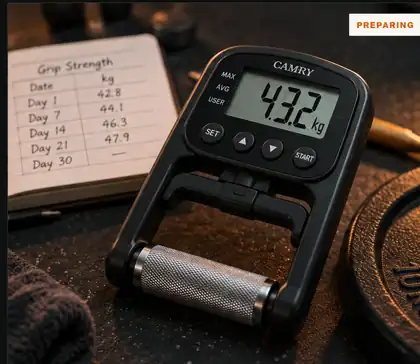
My CAMRY EH101 digital hand dynamometer is here. I plan to record my baseline on Sunday, October 18, and start 30 days of dead-hang practice on Monday, October 19. The point is to measure changes using the same method, not to guess.
If I practice dead hangs consistently for 30 days, will my measured grip strength and maximum hang time improve?
Measure right and left hand grip strength and establish a maximum dead-hang time.
Practice dead hangs consistently and record the work without turning every day into a max-effort test.
Check hanging endurance and note how the hands, forearms and shoulders are responding.
Repeat the same baseline testing setup and compare the results.
How I am using the CAMRY EH101 digital hand dynamometer to make my baseline and 30-day retest as comparable as possible.
Adjust the handle so the middle joint of the index finger is bent to approximately 90°. Photograph the setting, and do not change it between the baseline and final tests.
Keep the wrist straight or very slightly extended—not sharply bent up, down, or twisted.
Take a normal breath, squeeze smoothly as hard as safely possible for about five seconds while breathing, then release. Rest 60 seconds between efforts. Record three attempts per hand and compare the averages.
Use the same chair, handle setting, test order, posture and rest periods on Day 0 and Day 31. This is a personal experiment—not a diagnostic test. Avoid breath-holding, and get appropriate clearance before maximal-effort testing.