
Building Something Better Together
Why community, connection, and learning from one another might be among the most important experiments we undertake.
When I launched Lipusch Resilience earlier this month, I wrote about why I decided to build the website and what I hoped to accomplish. I wanted a place to share my research, document personal experiments, and explore ways to make the most of the years ahead. That original Field Note was really about my personal journey, the experiences that shaped my thinking, and why I felt compelled to start something new at 55.
But as I've continued working on the project, I've realized something important. The website itself isn't really the end goal. It's simply the foundation for something I find much more interesting: bringing together people who want to keep learning, challenging themselves, sharing experiences, and helping one another along the way. I don't want Lipusch Resilience to be a place where I simply write articles and hope somebody reads them. I'd much rather create something where people have an opportunity to participate and influence what it becomes.
That got me thinking more seriously about the role community has played in my own life. From athletics and professional relationships to friendships and family, some of my most meaningful experiences have involved people who encouraged me, challenged my thinking, or helped me see something from a different perspective. I started wondering what the research says about those connections and whether we could intentionally create an environment that encourages more of them.
The more I've explored the idea, the more convinced I've become that building a community might be the most worthwhile experiment I undertake with Lipusch Resilience. And unlike many of the personal experiments I have planned, this one isn't something I can do alone.
The People Around Us Matter More Than We Realize
I've been fortunate to have some incredible people in my life. Family, friends, coworkers, teammates, and people I've met through the different experiences and challenges I've taken on over the years. Some have pushed me physically, others have challenged me professionally, and a few have helped me navigate difficult periods when I needed a different perspective. Looking back, I can see how much of my own growth has been influenced by the people around me, sometimes without my even realizing it at the time.
Think about the times you've tried to make a meaningful change in your life. Maybe you decided to get back into shape, train for an event, change careers, learn a new skill, or finally address something you've been putting off for years. It's one thing to make that decision while sitting alone on your couch, feeling motivated by whatever inspired you that particular day. It's something entirely different when you have people around you who are encouraging you, holding you accountable, sharing their own experiences, or working toward similar goals.
I've certainly experienced both sides of that equation. I've participated in endurance events, competed in sports, pursued professional goals, and experimented with different approaches to improving my health. While personal discipline certainly matters, I've found that being surrounded by people who are motivated and engaged can make the experience more enjoyable and help me stay committed when my own motivation starts to fade. There's something about being part of a group that can make a difficult challenge feel a little more manageable.
And sometimes the value of those relationships has nothing to do with accomplishing a particular goal. Sometimes it's simply having someone to talk to who understands what you're experiencing, has been through something similar, or offers a perspective you hadn't considered. Those conversations can be especially valuable as we move through different stages of life, when our priorities, responsibilities, and circumstances inevitably begin to change.
There's Actually Some Science Behind This
As I started thinking more about the role community could play in Lipusch Resilience, I became curious about what the research had to say. We're constantly hearing about the importance of exercise, nutrition, sleep, and the many other things we're supposed to be doing to live longer and healthier lives. I'm certainly guilty of spending plenty of time researching those subjects myself, but I began wondering whether we give enough attention to another important part of our overall well-being: the quality of our relationships and the communities we belong to.
In 2023, the U.S. Surgeon General released an advisory titled Our Epidemic of Loneliness and Isolation, examining the importance of social connection and the consequences of lacking meaningful relationships. The report brought together evidence linking social connection with physical health, mental well-being, and resilience. One of the things that stood out to me was the idea that our relationships aren't simply something that makes life more enjoyable. They're an important part of maintaining our health and quality of life.
That made me think differently about the communities I've belonged to over the years. Whether it was training alongside other athletes, spending time with friends, participating in professional organizations, or simply having people to exchange ideas with, those experiences offered benefits that extended beyond the activity itself. There was often a sense of belonging, a shared purpose, and the opportunity to learn from people whose experiences were different from my own.
Research into group participation and physical activity also suggests that social support, belonging, and shared identity can play a role in how people engage with exercise and other healthy behaviors. That doesn't mean joining a group automatically makes someone healthier, more motivated, or more successful. Personal circumstances and individual effort still matter, and group activities don't necessarily outperform individual approaches in every situation. What interests me is the possibility that having the right people around us can make the process of pursuing our goals more engaging and sustainable.
We spend plenty of money on fitness equipment, tracking devices, supplements, apps, and other tools designed to help us improve. I use more than my fair share of those things myself. But perhaps one of the most valuable resources available to us isn't something we need to purchase. Maybe it's finding people who are curious about the same things, willing to share their experiences, and interested in making progress together.
What If We Started Experimenting Together?
One of the things I'm most excited about with Lipusch Resilience is the opportunity to run experiments, particularly ones that other people might be interested in trying themselves. I'm not talking about complicated clinical studies or pretending that a small group of people testing something for 30 days can produce definitive scientific conclusions. I'm talking about everyday people being curious enough to try something, measure their progress, share what they learn, and perhaps discover something useful along the way.
For example, I'm preparing to begin a 30-day grip-strength experiment. I've purchased a grip-strength testing device, and my plan is to establish a baseline, follow a consistent testing process, work on improving my strength, and measure the results at the end of the month. Grip strength has become an interesting area of research because of its associations with physical function and broader health outcomes, so I'm curious to see what kind of improvement I might be able to make through a deliberate training effort.
Now imagine if ten other people decided to participate in a similar experiment. We might have people of different ages, fitness levels, and backgrounds all starting from different baselines. Some might experience significant improvements, while others might see very little change. Someone could discover that a particular training approach works well for them, while another person might find something entirely different. Along the way, we'd have opportunities to compare notes, ask questions, encourage one another, and potentially learn things that none of us would have discovered individually.
Would that qualify as rigorous scientific research? Of course not. There would be far too many variables, and everyone's circumstances would be different. But that doesn't mean the experience couldn't be valuable. If we approach these experiments with curiosity, reasonable expectations, and a willingness to share both successes and disappointments, there's an opportunity to make the process more interesting and meaningful for everyone involved.
And I certainly don't want every experiment to revolve around physical health. Maybe someone is interested in improving their sleep, developing a daily walking habit, learning how to use artificial intelligence, experimenting with a different nutritional approach, or challenging themselves to do something they've always been uncomfortable trying. There's no shortage of possibilities, and I suspect some of the best ideas will eventually come from the people who join the community rather than from me.
The goal isn't to prove that one approach works for everyone. It's to create an environment where we can learn from trying, share what happens, and hopefully encourage one another to keep moving forward.
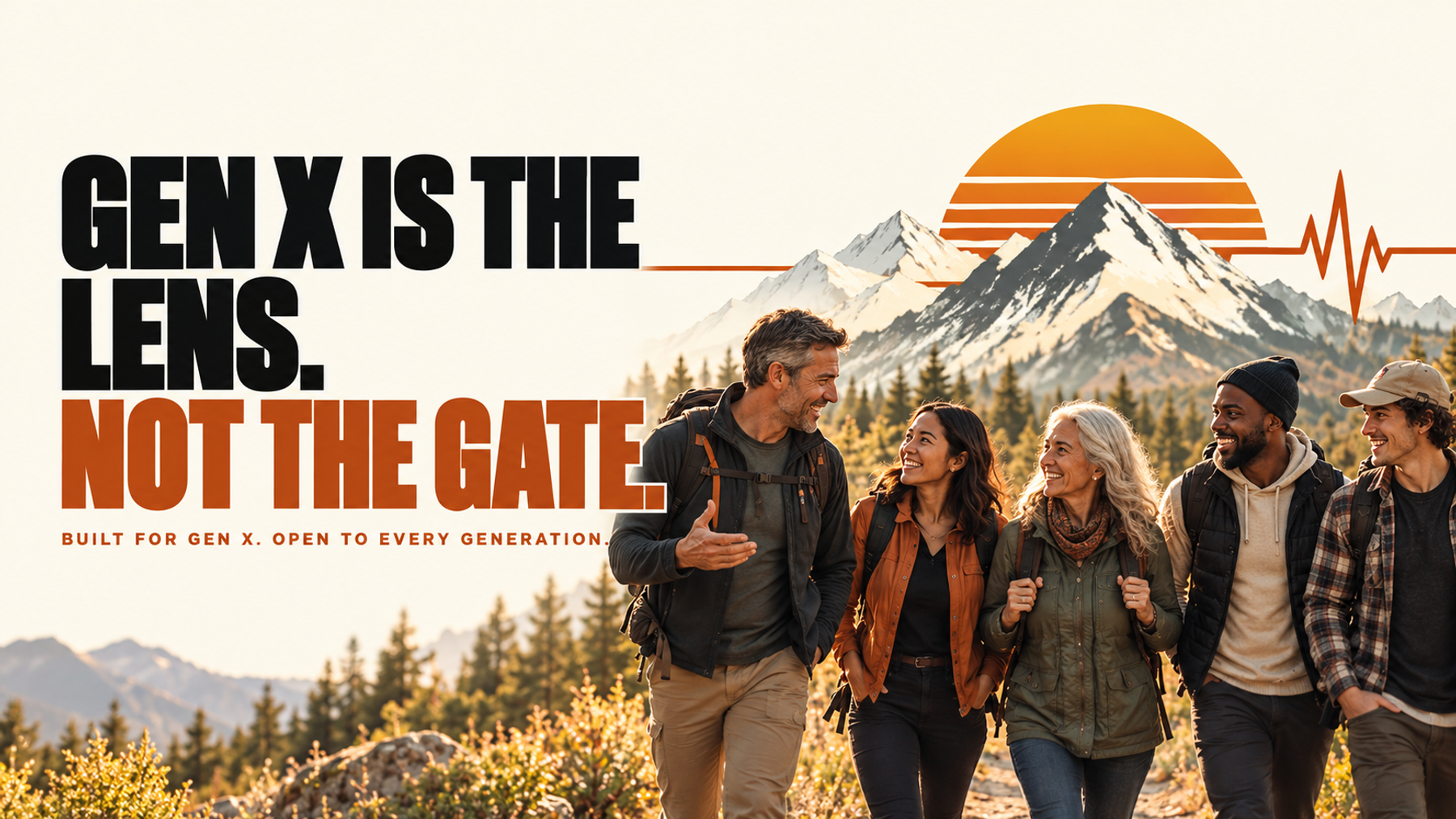
Gen X Is the Lens. Not the Gate.
If you've spent any time looking around the Lipusch Resilience website, you've probably noticed the phrase Built for Gen X. That's intentional. I'm a proud member of Generation X, and much of what I'm exploring comes from where I happen to be in life right now. At 55, I'm thinking about things I wasn't particularly concerned about at 25 or 35. Staying healthy, remaining physically capable, continuing to learn, finding purpose, and making sure the next several decades are filled with experiences rather than limitations have all become increasingly important to me.
But I don't want this to be a community exclusively for people my age. In fact, I think limiting participation to one generation would eliminate some of the most valuable opportunities for learning. One of my favorite lines on the website is Gen X is the lens. Not the gate, because it captures exactly how I feel about bringing different generations together.
If you're a Baby Boomer, you've already navigated stages of life that I'm just beginning to think about. I'm interested in what you've learned, what you might do differently, and what continues to motivate you today. If you're a Millennial, you're likely dealing with your own combination of career decisions, family responsibilities, financial considerations, and personal ambitions. Your perspective on those challenges might be quite different from mine, and that's precisely why I'd like to hear it.
And if you're part of Gen Z, I suspect there are plenty of things you could teach those of us who have been around a little longer, particularly when it comes to technology, communication, and how the world continues to evolve. At the same time, perhaps there's value in seeing how older generations have navigated challenges, made mistakes, changed direction, and continued building their lives along the way.
There's growing interest in the benefits of intergenerational programs, including research suggesting that bringing people of different ages together may support social connection, inclusion, and aspects of mental well-being. The evidence is still developing, but the underlying idea makes a lot of sense to me. We don't all need to be the same age, share the same background, or be at the same stage of life to have something meaningful in common. Sometimes the differences between us are exactly what make the conversations worthwhile.
Different ages. Different vantage points. Plenty to learn from each other.
A Community Where Nobody Has to Have All the Answers
One thing I definitely don't want Lipusch Resilience to become is another place on the internet where everyone pretends to have everything figured out. There's already more than enough of that. Spend five minutes scrolling through social media and you'll find someone explaining the perfect diet, the ideal workout, the secret to happiness, or how to completely transform your life in 30 days. Some of those people may have genuinely figured out approaches that work for them, but I've been around long enough to know that life is rarely that simple.
I've had successes, setbacks, experiences that changed my perspective, and plenty of occasions when something I believed to be true turned out to be more complicated than I originally thought. I've learned that being curious and willing to reconsider my assumptions is far more valuable than pretending I always know the answer. That's the approach I want to bring to this community, and I hope others will feel comfortable doing the same.
I'd love for people to share what's working for them, what hasn't worked, and what they're still trying to understand. I want questions to be welcomed, personal experiences to be respected, and disagreements to lead to thoughtful conversations rather than arguments. We won't necessarily agree on everything, nor should we. If everyone approaches a problem from exactly the same perspective, we're probably missing opportunities to learn something new.
I also recognize that people will come to this community for different reasons. Someone might be focused on improving their health, another person might be navigating a career transition, and someone else might simply be looking for a little motivation to get started on something they've been putting off. My hope is that those different interests can coexist, creating opportunities for conversations and connections that might not happen otherwise.
So What Does This Community Actually Look Like?
That's the exciting part, because I don't know exactly what it will look like yet. Lipusch Resilience is still a very new website, with Field Notes, developing experiments, challenges, and a newsletter I've named The Dispatch. Those are the starting points, but I see them as tools for bringing people together rather than the final destination.
Over time, I'd love to see people participating in shared challenges, comparing results, recommending useful research, suggesting new experiments, and helping one another navigate the different stages of life. I can imagine conversations about staying physically active in our 50s, 60s, and beyond, as well as younger people sharing ideas about emerging technologies that completely change how some of us approach our work or daily routines. Maybe someone training for their first 5K connects with a person who's completed dozens of endurance events. Maybe someone preparing for retirement learns from another person who's already made that transition.
The possibilities are exciting, but I'm also trying to be realistic about what I'm building. I don't have aspirations of turning this into some enormous organization, and I'm certainly not interested in creating another online space where thousands of people sign up but nobody actually interacts. I'd much rather start with a smaller group of genuinely engaged people who are willing to participate, share ideas, and help one another.
I also don't want to determine everything about the community myself. I'd rather have the people who become involved help shape what it eventually becomes. If certain experiments generate interest, we can explore them further. If people want to organize challenges, exchange research, or create conversations around particular topics, those are things we can figure out together. Some ideas will work, others probably won't, and I suspect we'll learn quite a bit along the way.
In many respects, building the community itself may turn out to be one of the most interesting experiments I undertake. And rather than just continuing to talk about the idea, I've decided it's time to actually get started.
I've officially created Lipusch Resilience | The Community, a private Facebook group where people can connect, exchange ideas, ask questions, share experiences, and participate in the experiments and challenges we're developing. The group is brand new, and right now we're starting from scratch. But that's part of what makes this exciting. The people who join early will have an opportunity to help shape the conversations, suggest new ideas, and influence what this eventually becomes.
The group is private, meaning discussions are visible only to members, but it's open to anyone interested in participating, regardless of age or background. You don't need to be an expert, have everything figured out, or even be particularly interested in fitness. All you need is a little curiosity, a willingness to share, and an interest in learning from other people.
Join Lipusch Resilience | The Community on Facebook
I don't know whether this will eventually become a community of 20 people, 200 people, or something much larger. I'm more interested in the quality of the conversations than the number of members. If we can create a place where people genuinely enjoy sharing experiences and helping one another, I'll consider that a pretty good start.
An Invitation to Build Something Together
If you've made it this far, I'm guessing something about this idea resonates with you. Maybe you're interested in improving your health, staying physically capable as you get older, learning a new skill, or finding motivation to tackle something you've been putting off. Maybe you've had an experience that could help someone else, or perhaps you're simply curious about what other people are trying and learning.
Whatever brought you here, you're welcome. And now there's an actual place where we can begin having those conversations. I've created a private Facebook group called Lipusch Resilience | The Community, and I'd love for you to be part of it. You can introduce yourself, tell us what you're working on, ask questions, suggest an experiment, or simply follow along until something catches your interest. There's no pressure to participate in everything, and you certainly don't need to have all the answers.
Request to Join Our Private Facebook Community
I'd also encourage you to subscribe to The Dispatch, where I'll share new Field Notes, research, experiment updates, and community news. The website will remain the home for all of that information, while the Facebook group gives us a place to continue the conversations.
I'm fully aware that building an engaged community doesn't happen overnight. It takes time, trust, participation, and a willingness to keep showing up even when things don't develop as quickly as we'd hoped. Right now, I'm still at the very beginning, figuring things out as I go and trying to create something that people might genuinely enjoy being part of. I don't know exactly where it will lead, and I'm surprisingly comfortable with that.
Over the years, I've learned that some of the best things in life don't begin with a perfect plan. Sometimes they start with an idea, a little curiosity, and a few good people willing to come along for the ride. That's what I'm hoping to find here, and perhaps what we can build together will become more valuable than anything I could have created on my own.
I think we've still got a lot of good years ahead of us. We might as well help each other make the most of them.
Gen X is the lens. Not the gate.
Built for Gen X. Open to every generation.
Research & Further Reading
U.S. Surgeon General (2023)
Our Epidemic of Loneliness and Isolation: The Healing Effects of Social Connection and Community.
https://www.ncbi.nlm.nih.gov/books/NBK595227/
Intergenerational Interventions and Their Impact on Active Aging (2025)
A systematic review examining the potential benefits of bringing younger and older generations together, including social connection, well-being, and reducing age-related stereotypes.
https://pubmed.ncbi.nlm.nih.gov/40914710/
Circumstances That Promote Social Connectedness in Older Adults Participating in Intergenerational Programmes With Adolescents (2023)
A review exploring how structured interactions between generations can promote meaningful social connections.
https://bmjopen.bmj.com/content/13/10/e069765
This is Jeremy's experience, research and interpretation—not medical advice. The point is to share the experiment, not hand out a universal answer.