
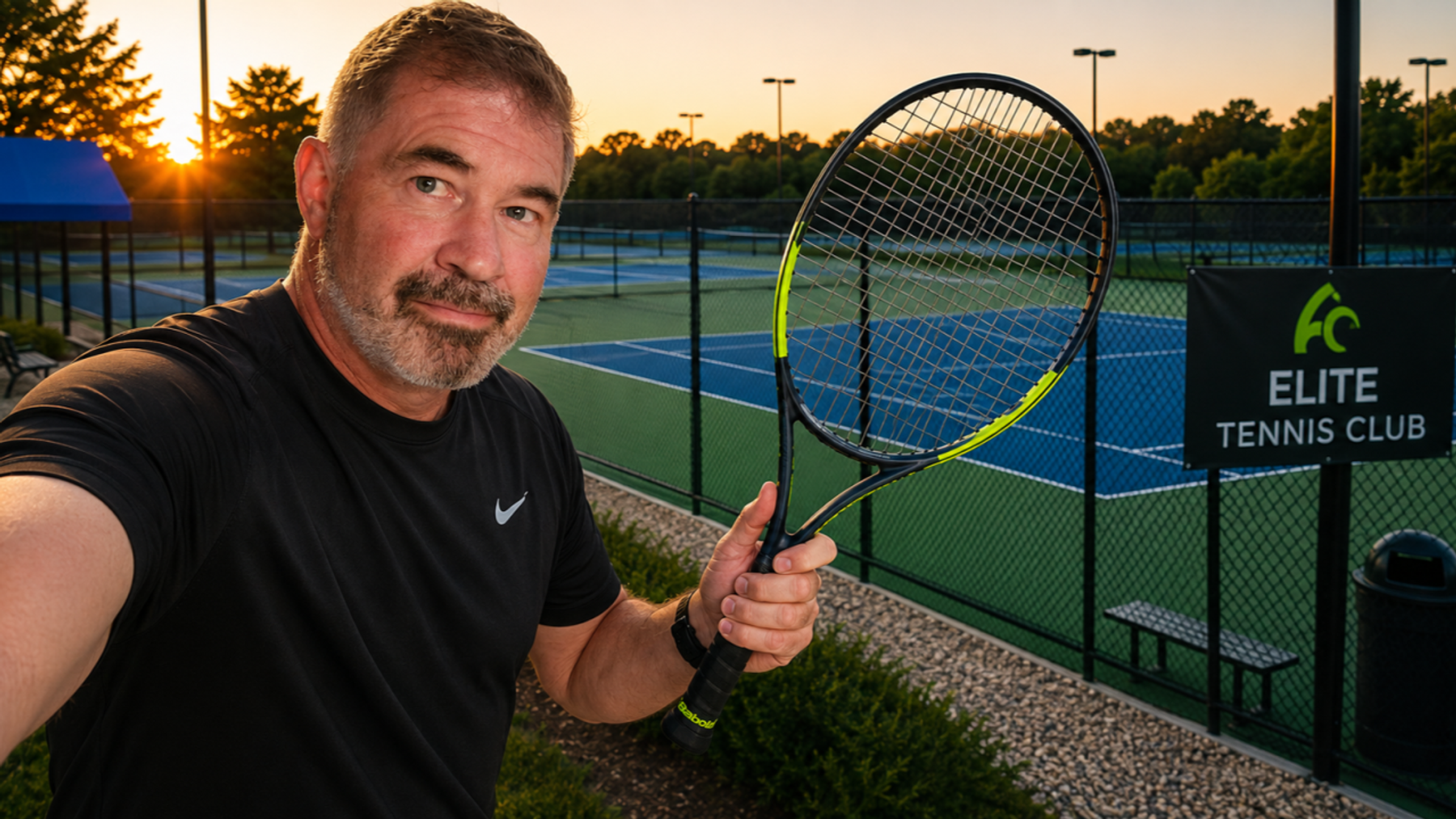
Coming Back to Something I Loved
A few years ago, I started playing tennis again. At first, I thought I was simply looking for another way to stay active, but looking back, I think I was rediscovering something that had been part of my life for much longer than I realized.
I started playing when I was around seven years old and continued through middle school and high school, eventually earning a varsity spot as a sophomore. During those years, a good friend and I spent countless hours on the court. We loved the competition, but we also loved the process of getting better. There was always something to work on, something to figure out, and another match waiting to test whether any of it was actually working.
Tennis stayed with me into college, where my friend and I played intramurals and won the league a couple of times. At that age, I probably assumed the game would always be there. Then adulthood did what adulthood tends to do. Career, marriage, family, kids’ activities, work schedules, and all the other responsibilities that fill the middle decades gradually took over.
Tennis didn’t disappear because I stopped loving it. It simply kept moving lower on the priority list until years had quietly become decades. As my children got older and began building lives of their own, something unfamiliar started to happen: I had a little more time. Not unlimited time, but enough to begin asking a question I hadn’t asked in a very long while. Could I still play, and would the game still feel like mine?
The Game Came Back
Returning after so many years was humbling at first. Some things felt surprisingly familiar, while others reminded me very quickly how long I had been away. The timing wasn’t quite right, the movement wasn’t automatic, and shots that once felt natural required more thought than I remembered.
Gradually, though, the game started coming back. It took a year or two before I felt like I was really playing tennis again rather than simply attempting to recreate something from my past. The touch returned, the confidence returned, and the instincts began showing up again. More importantly, the enjoyment came back, and that may have been the biggest surprise of all. I had forgotten just how much I loved the game.
What I appreciate about tennis now is also different from what I appreciated when I was younger. Back then, I probably thought success had a lot to do with hitting harder, moving faster, and overpowering the person across the net. I still enjoy pace and competition, but now I notice the strategy much more. Every match becomes a series of problems to solve: what is working, what isn’t, where the other player is uncomfortable, what pattern keeps repeating, and whether I can change something before they do.
A small adjustment in positioning, shot selection, patience, or tempo can completely change the direction of a set. There is a chess match happening underneath the physical game, and the older I get, the more interesting that part becomes.
What Surprised Me Most Wasn’t Tennis
As much as I enjoy competing again, the thing that surprised me most about returning to tennis wasn’t actually the tennis. It was the people. When I came back to the sport, I thought I was signing up for exercise. What I found was a community.
Every Tuesday night, I play doubles with a rotating group of players. During the indoor season, we compete, work on our games, give each other a hard time, and gradually settle into the rhythms that come from seeing the same people week after week. Then summer arrives and things become even more competitive, because the people you spent the winter playing alongside can suddenly end up across the net from you.
Some of my favorite matches are against friends I’ve played with for years because there is something fun about wanting very badly to beat someone and then laughing about it together afterward. Over time, traditions started forming around the tennis too: summer get-togethers, food and drinks after the indoor season, and what we jokingly called a banquet that eventually started feeling suspiciously like an actual banquet.
Somewhere along the way, a collection of people who showed up to hit tennis balls became a group of friends. That mattered more than I expected, and it reminded me that activities can give us much more than exercise if we stay around long enough for the community to form.
A Different Picture of Getting Older
One of the things I appreciate most about our tennis group is the range of ages on the court. On any given night, people at very different stages of life can be competing against one another. Some are still deep into careers and raising families, while others are approaching retirement or already there. Outside the tennis club, our lives may look very different, but for a couple of hours on the court most of that disappears.
We are all just tennis players trying to win the next point, and there is something powerful about seeing people older than you still moving, competing, learning, and caring about whether a ball lands two inches inside or outside a line. It gives you a very different picture of what aging can look like. Getting older does not automatically have to mean becoming a spectator.
That has become increasingly important to me. I am less interested in exercise simply because someone says it is optimal and more interested in activities that help preserve the ability to participate in life. Tennis makes that idea tangible because you need balance, coordination, endurance, reaction time, decision-making, and enough strength and mobility to move around the court. You also have to stay mentally engaged because every point gives you another problem to solve.
Then there is the social side, which may be every bit as important. You have a reason to leave the house, people expect you to show up, you compete, you laugh, you talk afterward, and over time you build friendships around something you genuinely enjoy doing. That combination is difficult to reproduce on a treadmill.
The Best Exercise Might Be the One You Miss
There is plenty of discussion about the best way to exercise as we get older. Strength training matters. Cardiovascular fitness matters. Mobility matters. There are excellent reasons to pay attention to all of them, but I think enjoyment deserves a place in that conversation too.
The most scientifically perfect workout doesn’t help very much if you stop doing it after six weeks. An activity that keeps pulling you back year after year may have an advantage that is harder to measure. For me, tennis does that because I don’t have to manufacture a reason to play. I look forward to it. Competition makes me want to improve, the social part makes me want to show up, and the fact that there is always another part of the game to work on keeps it interesting.
That doesn’t mean tennis replaces everything else I should be doing. It means the sport gives the rest of the work a purpose. Strength matters because I want to move better on the court. Conditioning matters because I don’t want my legs deciding the outcome of a match before my brain does. Mobility matters because I want to continue reaching balls that require me to move in ways everyday life rarely demands.
The sport creates a reason to maintain capability, and that feels very different from exercising simply because I think I’m supposed to.
Sometimes You Don’t Need to Find Something New
There is a tendency, especially when we start thinking seriously about health and longevity, to search for the next thing. A new workout, a new protocol, a new piece of technology, or a new habit that promises to make us a slightly better version of ourselves. Sometimes that exploration is useful, and I enjoy it.
Returning to tennis reminded me, though, that not everything valuable has to be new. Sometimes something that mattered to you years ago is still sitting there, waiting for another chapter. Coming back to tennis gave me exercise, but it also gave me competition again. It gave me a community I didn’t realize I was missing, something to practice, something to look forward to, and another way to think about the kind of older person I want to become.
Most importantly, it reminded me that staying capable isn’t only about adding years to life. It is about protecting the things that make those years feel like yours. For me, one of those things happens to involve a racket, a net, a yellow ball, and a group of people I’m still trying very hard to beat.
Sometimes the best things in life don’t need to be discovered. Sometimes they simply need to be found again.
Looking Back From Here
When I first wrote about returning to tennis, I was thinking mostly about the sport and the community that came with it. Looking at it through the lens of Lipusch Resilience now, I see another reason the experience mattered so much: tennis gave me a very practical definition of capability.
Capability isn’t an abstract score. It is being able to move when the point requires it, recover and do it again, think clearly while you’re tired, and keep participating in something you genuinely enjoy. That is becoming one of the central questions behind Lipusch Resilience: what are we trying to preserve as we get older, and what kind of work gives us the best chance of preserving it?
I don’t think everyone needs to play tennis, but I do think there is value in finding something that makes you want to stay strong enough, fit enough, mobile enough, and engaged enough to keep doing it.
For me, I was lucky enough to realize I had already found mine years ago. I just needed to come back to it.
This is Jeremy's experience, research and interpretation—not medical advice. The point is to share the experiment, not hand out a universal answer.